
UltraSense Research Explores Wearable Bioimpedance Monitoring Across Different Body Locations
New research from the University of Oulu demonstrates how low-cost wearable bioimpedance technology can support accurate body composition estimation regardless of sensor placement.
Researchers from the University of Oulu, a partner in the UltraSense project, have contributed to a new scientific publication entitled Prediction of Body Composition with a Low-Cost and Wearable Bioimpedance Analysis Device Across Various Body Locations. The work investigates how wearable bioimpedance analysis (BIA) can be used to estimate body composition using measurements collected from different parts of the body.

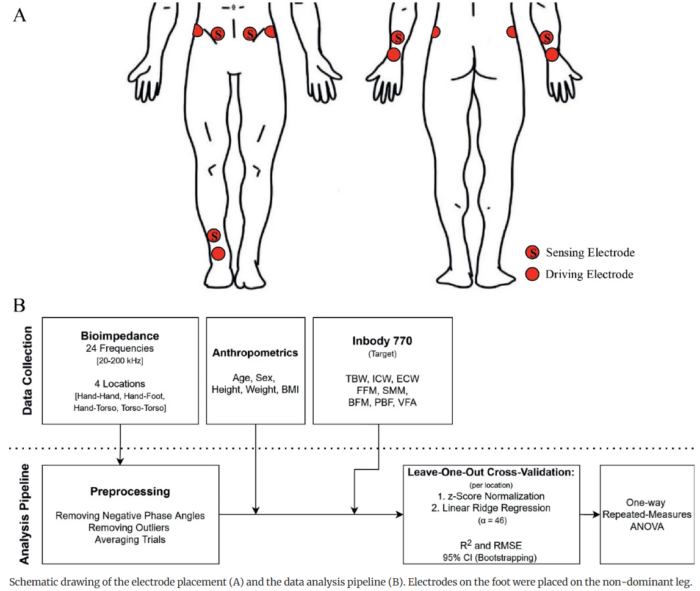
Body composition monitoring plays an important role in understanding health status and metabolic conditions. Traditional measurement approaches often require specialised equipment or specific electrode placements, which can limit their usability in everyday settings. This research explores a more flexible approach based on a wearable and low-cost bioimpedance device, assessing whether accurate predictions can be obtained independently of the device’s position on the body.
The results demonstrate the potential of wearable bioimpedance technology for reliable body composition estimation across multiple body locations. These findings support the development of user-friendly monitoring solutions that can be more easily integrated into everyday life while maintaining measurement accuracy.
Within UltraSense, this research contributes to the project’s broader objective of developing innovative wearable technologies for continuous and non-invasive health monitoring. By improving the flexibility and practicality of bioimpedance-based measurements, the work supports future solutions for the monitoring and management of obesity, metabolic syndrome and related health conditions.
The UltraSense consortium congratulates the University of Oulu team on this contribution and its continued efforts to advance wearable sensing technologies.
🔗 Read the full publication: https://link.springer.com/chapter/10.1007/978-3-032-28829-5_13